



Jump to section
Looking for the best customer onboarding software for your SaaS team? We compared 14 tools across five categories.
If you're running a SaaS or tech company, one thing is for sure – at some point, you'll need a better way to onboard new customers than long email threads, a tracking spreadsheet nobody quite trusts, and a growing pile of ad-hoc forms. Whether it's getting enterprise accounts live in weeks instead of months, giving every customer a personalised onboarding that fits the exact modules they bought, or keeping an overview of every active onboarding in one place, a proper onboarding tool quickly becomes non-negotiable.
When that need hits, having the right platform for your specific setup matters. And not all customer onboarding tools are built the same. The ideal one depends on whether you're running high-touch implementations or lean, self-serve onboarding – and on things like how deeply it plugs into your CRM, how much the AI actually changes the work, and – just as importantly – the pricing.
That's why we compared the best customer onboarding platforms in 2026. Some are built for enterprise professional services teams, others are stripped-down checklists, and a few (including ours) cover the full customer onboarding journey end-to-end. Take a look at our guide and find the one that fits.
The main aspects we reviewed are:
- Fit for SaaS and techonboarding: Is it actually built for post-sale, or a digital sales room with onboarding bolted on?
- Depth of customer collaboration: Task tracking, mutual action plans, forms, video, analytics – what your customers actually see and do during the onboarding.
- CRM and tooling integration: HubSpot, Salesforce, Zapier, Make, API – how tightly it wires into your stack.
- AI capability: Is AI embedded in a way that changes how the work gets done, or is it bolted on?
- Pricing transparency: What you pay at entry, and what sits behind "Contact us".
TLDR? Here are our favourite tools across the customer onboarding stack:
- Customer onboarding platforms: Valuecase
- Enterprise PSA (professional services automation): Rocketlane
- Digital adoption (in-product onboarding): Userpilot
- Customer success platform: ChurnZero
- Product analytics for onboarding: Mixpanel
Below, we'll go through each category – what it's for, who it fits, and which tools to look at.
Where onboarding software sits in the post-sale stack
The category goes by several names depending on who's asking. Teams describe the same purchase as a client portal, a workspace for client implementations, a platform for managing the post-sale client experience, or simply a better way of tracking new client progress than a spreadsheet. They all point at the same gap: once the contract is signed, the work runs across two companies, and most internal tooling only covers one of them.
That's the line worth drawing before you shortlist. General project tools – monday.com, Asana, Notion, ClickUp, Trello – are built to run client project workflows on your side of the boundary, and they do that well. What they aren't is customer-facing: no branded portal your customer can open without an account, no reminders chasing the customer's own tasks, no signal telling you whether they ever opened anything. A purpose-built platform covers the other half – the surface your customer actually uses, plus visibility across every new customer setup at once.
The five categories below split along that same line. Customer onboarding platforms and PSA tools give you a customer-facing surface and control over implementation timelines. Digital adoption, customer success and product analytics tools each solve a different part of the lifecycle, and are worth knowing so you don't buy one expecting another.
Customer onboarding platforms
Customer onboarding platforms are purpose-built for the phase between closing the deal and getting the customer fully live. They give your customer one central link where the plan, tasks, resources, and key people all come together. At the same time, your team gets a clear overview of every active onboarding — so nothing slips, no one loses track, and no account quietly stalls for two months without anyone noticing.
These are the tools most B2B SaaS teams shortlist against each other when they stop wanting to run onboarding out of email threads and spreadsheets. High-touch enough to handle multi-stakeholder implementations, light enough to actually get used.
1. Valuecase
Valuecase is an AI-native customer onboarding platform for B2B SaaS and tech companies.
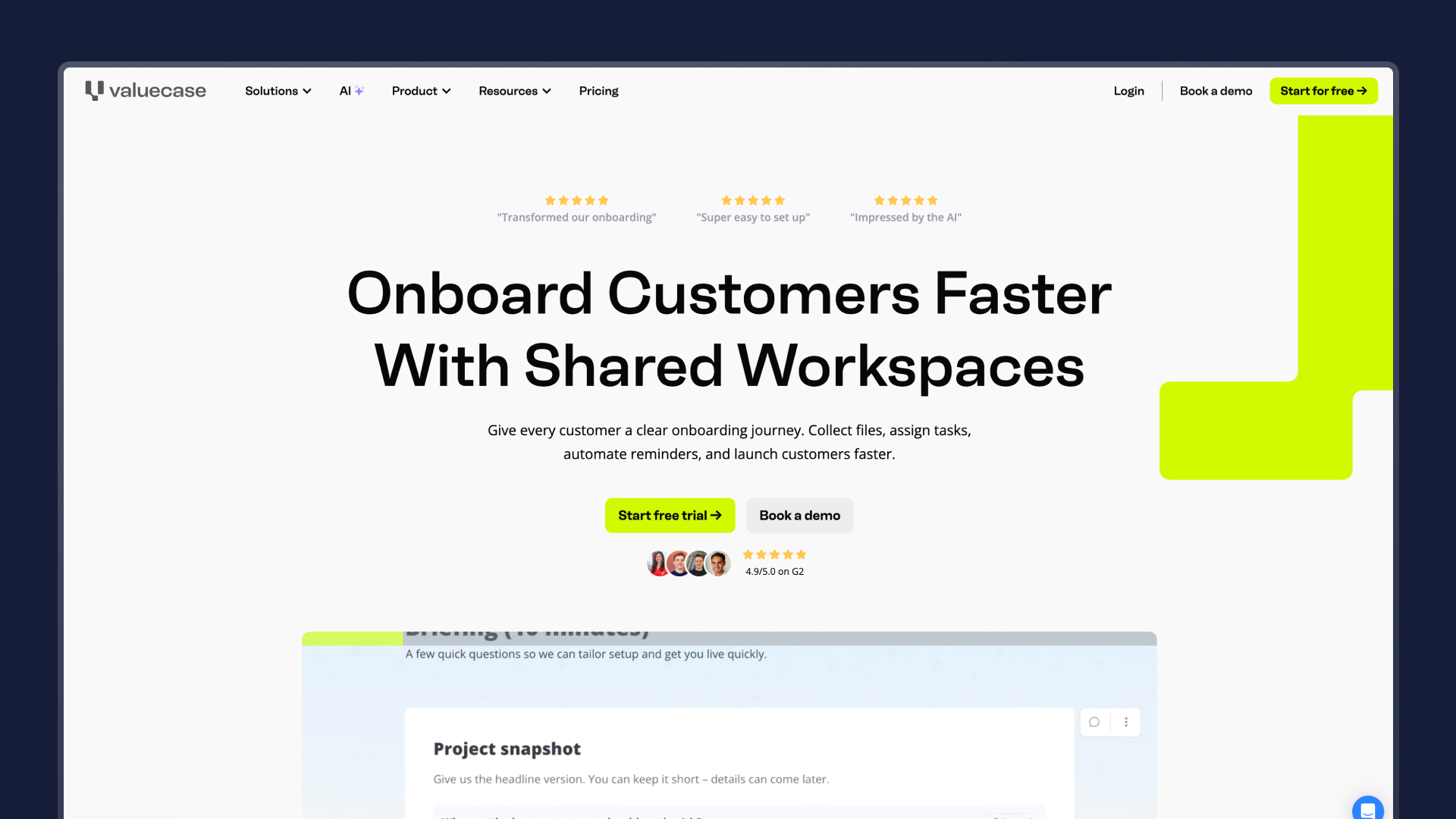
The platform has two main parts:
- Each customer gets a branded Space that combines the onboarding plan, tasks, forms, resources, videos, and key stakeholders in one shareable link – no login required on their side.
- Your team gets a dashboard across every active onboarding, with Kanban, Gantt, and custom saved views.
Compared to similar platforms, Valuecase differentiates through best-in-class usability, automation, and AI capabilities.
Inside a Space, you get the things that actually move the needle on modern onboarding: easy to use onboarding plans that can be used for low touch onboardings, but also adapt to complex projects. Forms that auto-save, validate data, and can be downloaded as a PDF or CSV. Flexible content block to host resources. As well as a chat to communicate with customers.
Valuecase Spaces are not only designed for ease of use, they can also be personalized to your customer, including multi-language support (EN, DE, NL, FR, ES and more), hiding / showing of sections or milestones, and more.
And for higher volume use cases, extensive automation capabilities enable your team to create and update Spaces on auto-pilot.
AI is built into the platform. A general-purpose AI agent works across the whole product: drafting content in a Space, updating plans, answering questions on customer data, and surfacing risk across your portfolio.

MCP support means external agents like Claude or ChatGPT can plug straight in and act on your Valuecase data – useful once your team starts building custom agents for the specific parts of onboarding you care about.
CRM integrations go deep with both HubSpot (including custom objects and deal stages) and Salesforce, and the stack extends to Zapier, Make, a Chrome extension, and a full public API. If your revenue ops setup evolves, you're not locked in. Enterprise teams get multi-team management with separated content and permissions, ISO 27001 certification, and EU data hosting.
Pricing starts at €59/month with no seat or plan minimum, and AI is included in every plan rather than sold as a per-user add-on.
Key onboarding features:
- AI agent built into the full product (not a bolt-on) + MCP support
- Shared onboarding Spaces – no login required for customers
- Forms, action plans, content, chat – all in one Space
- HubSpot (incl. custom objects), Salesforce, Zapier, Make, public API
- Starts at €59/month, no seat minimums, AI included
2. Dock
Dock started as an onboarding solution and has now expanded into what it calls an AI Revenue Enablement Suite – 14+ products spanning Deal Rooms, Playbooks, CPQ, a CMS, an AI Agent, and Onboarding. The centre of gravity is nowfirmly pre-sale: Deal Rooms for sellers, sales content, and AI aimed at sales enablement. Onboarding sits inside that suite as a post-sale module rather than the product it was built around.
If you want a sales room first and onboarding as an adjacent module on the same subscription, Dock fits that shape. If you're evaluating specifically for the post-sale customer onboarding journey, the in-Space capabilities are lighter than a purpose-built onboarding platform:
no Gantt timeline, no native video, no multi-language support, no conditional-logic forms, and the dashboard sticks to a list view without Kanban or custom saved views. AI is packaged as an Enablement Agent plus AI-authored documents rather than a general-purpose agent across the product. There is no MCP support or agent builder within the product (as of May 2026).
CRM coverage is solid – HubSpot (including custom objects) and Salesforce are both supported. On the admin side, Dock is GDPR compliant but doesn't carry ISO 27001 certification or offer EU data hosting; content management is gated to the Premium tier.
Dock starts at $350/month, with key features like content management, white-label branding, and playbooks gated to the $1,000/month Premium plan.
3. Arrows
Arrows splits its product into two separate tools: Sales Rooms and Onboarding Plans, sold as separate SKUs. Integrations with HubSpot (including custom objects) and Salesforce are the main draw – automations fire off CRM events like auto-completing a task when a HubSpot property changes. If your onboarding workflow is deeply HubSpot-driven, that's the hook.
The feature set inside an onboarding plan covers the essentials – tasks with owners, due dates, file uploads, form submissions, e-signatures, embedded Calendly or Loom – without going further. Forms don't support conditional logic, there's no Gantt view, no native video, no multi-language support, and no live chat. Dashboard views are limited to a list – no Kanban or custom saved views. AI is scoped to five fixed sales-room content blocks (ROI, Why now, Cost of inaction, What we heard, Next steps) rather than a general-purpose agent.
On the admin side, Arrows is GDPR compliant but doesn't carry ISO 27001 certification, doesn't offer EU data hosting, and doesn't include a built-in content management system or multi-team separation.
Pricing is only available on request but starts around $500+/month with minimum commitment of 100 onboarding plans or 200 sales rooms on entry tiers – pricing scales with customer volume rather than seats.
Enterprise PSA (professional services automation)
When "customer onboarding" is really "project delivery that's billed by the hour," you're in PSA territory. Enterprise PSA platforms bundle timesheets, resource and capacity planning, rate cards, invoicing, and margin tracking into the same tool the onboarding plan lives in – because in this world, onboarding is a line item on the services P&L, not just an experience layer.
PSA is heavier than a customer onboarding platform and almost always priced per seat with minimums. If you want and all-in-one solution and you're running a billable services business, a professional services arm inside a software company, or a large implementation team that needs utilisation and margin reporting alongside the project plan, this is where to look.
4. Rocketlane
Rocketlane is a full PSA platform for professional services teams. On top of the onboarding plan, you get timesheets, resource and capacity planning, rate cards, invoicing, and project budgets with margin tracking – all inside the same product. The Space your customer sees is effectively a client portal: a surface to view the project plan, documents, and updates.
If you run a billable services business where utilisation, forecasting, and invoicing have to sit next to the implementation plan, Rocketlane covers that end-to-end. If you don't, you're paying for a lot of functionality your team won't touch.
Pricing starts at $245/month ($49 per user with a 5-user minimum), and AI is split across paid add-ons priced at $69–$109 per user per month on top of the seat license.
5. GUIDEcx
GUIDEcx is a veteran PSA-style customer onboarding platform serving a similar buyer to Rocketlane. Its strengths are dependencies-first task management – tasks gate each other based on predecessors – a dedicated client portal, and deep project reporting aimed at larger professional-services organisations.
Where Rocketlane leans into services financials (timesheets, rate cards, margin tracking), GUIDEcx leans more into implementation project management at scale. If you're picking between the two, the decision often comes down to whether your priority is billing-and-resourcing or project-control-and-governance.
6. Kantata
Kantata (formed from the merger of Mavenlink and Kimble) is the heaviest option in the PSA category – enterprise-scale professional services automation with deep resource management, project accounting, and financial forecasting. Onboarding is a use case inside a much larger services-delivery platform.
Kantata fits organisations running hundreds of concurrent billable projects where utilisation reporting, multi-entity financials, and integration with ERPs like NetSuite and Workday are the actual buying criteria. Overkill for most SaaS onboarding teams; the right answer for a handful of enterprise services organisations.
Digital adoption (in-product onboarding)
Digital adoption platforms live inside your product, not around it. Their job is to walk users through the first-run experience with tooltips, tours, checklists, and in-app hotspots – showing people what to click next without a human in the loop.
They're a natural fit for low-touch, product-led SaaS – products simple enough that a well-placed tour beats a kickoff call. Most mature teams combine an in-product adoption layer with a customer-facing onboarding platform for high-touch accounts; they solve different halves of the same problem.
7. Userpilot
Userpilot is one of the better-known digital adoption platforms – in-product walkthroughs, tooltips, onboarding checklists, and event-based triggers, with user segmentation on top. Teams use it to build product-led onboarding flows that adapt to who the user is and where they are in the product.
It's a solid pick if most of your onboarding happens inside the app and your CS team doesn't need to sit on kickoff calls with customers. It won't help you run a high-touch implementation plan with external stakeholders – different problem.
8. Product Fruits
Product Fruits is a lighter, newer digital adoption platform with onboarding tours, checklists, in-app hotspots, and NPS surveys. The feature set overlaps heavily with Userpilot and Appcues, and it's commonly chosen on price – teams that want the core digital adoption layer without the enterprise pricing of the incumbents.
Good fit for early-stage and mid-market SaaS teams who want in-product guidance without committing to a heavier platform.
9. Intercom
Intercom is primarily a customer messaging platform – chat, help centre, Fin AI for support – but it also ships in-app product tours and message campaigns that can be triggered by user events. Teams already using Intercom for support often extend it into onboarding by firing contextual messages based on what the user just did (or didn't do).
If you're buying Intercom purely for onboarding, you're paying for a lot of messaging infrastructure you may not need. If it's already in your stack for support, the onboarding layer is a reasonable bolt-on.
Customer success platforms
Customer success platforms are for teams managing the entire customer lifecycle, not just the first 90 days. Onboarding is one workflow in a broader picture that includes health scoring, renewal forecasting, playbook automation, and CS team operations.
The trade-off is depth on onboarding itself – the customer-facing surface in a CS platform is usually thinner than a purpose-built onboarding tool. If your team's bigger concern is internal CS operations rather than the polish of the customer-facing experience, this is where to look.
10. ChurnZero
ChurnZero is a customer success platform covering onboarding alongside renewal, health scoring, playbooks, and in-app messages. Built for CS teams managing the full lifecycle from day one through renewal, not just the first few weeks.
ChurnZero's strength is the internal CS workflow – health scores, automated playbooks, renewal forecasting. The customer-facing layer is lighter than what you'd get from a tool focused specifically on the onboarding journey.
11. Planhat
Planhat is a data-heavy customer success platform built around a single customer 360°-view, with playbooks, health scoring, and revenue workflows on top. It sits between ChurnZero's simpler CS workflow and Gainsight's enterprise sprawl – more data depth than the former, less weight than the latter.
Planhat is a good fit for mid-market to enterprise CS teams where the data layer across the customer lifecycle matters more than the customer-facing polish of onboarding itself.
12. Gainsight
Gainsight is the enterprise customer success platform – customer 360°-view, health scoring, NPS, journey orchestration, and a CS Ops tooling suite at scale. It's the heaviest option in the category and priced accordingly.
Gainsight fits large enterprise CS organisations running dozens of CSMs, thousands of accounts, and complex health and outreach orchestration. Overkill for most mid-market teams; the right tool for a handful of enterprise customer success operations.
Product analytics for onboarding
Strictly speaking, product analytics tools aren't customer onboarding tools – they're the measurement layer behind onboarding. If you're running any kind of data-driven onboarding program, you're using one of these to track activation events, funnel drop-offs, and which features new users are (and aren't) engaging with.
Worth including because you'll see them on most onboarding tech-stack diagrams, and because the question "is our onboarding actually working?" usually gets answered in a product analytics tool, not inside the onboarding platform itself.
13. Mixpanel
Mixpanel is the go-to product analytics tool for tracking activation events, funnels, cohort retention, and feature usage during onboarding. Teams use it to define what "activated" means for their product, instrument the events that signal it, and then measure how well onboarding drives customers to that point.
Not an onboarding tool on its own. The measurement layer behind most mature onboarding programs.
14. PostHog
PostHog is open-source product analytics with session replays, feature flags, A/B testing, and surveys bundled into a single platform. Teams often pick PostHog as an all-in-one, self-hostable alternative to running Mixpanel plus Amplitude plus a feature-flag tool separately.
A strong fit for engineering-led teams that want product analytics under their own control, and for teams already doing experimentation who'd rather not add a second tool for it.
How to choose the right customer onboarding tool for your team
With five categories on the table, the shortlist depends on three questions:
Is your onboarding high-touch or low-touch?
If your customers need a multi-week implementation with back-and-forth on tasks, documents, and stakeholders, you want a customer onboarding platform (Valuecase, Dock, Arrows) or – if services are billable and you need an all-in-one solution – an Enterprise PSA (Rocketlane, GUIDEcx, Kantata). If onboarding happens inside the product with no human on the other side, a digital adoption platform (Userpilot, Product Fruits, Intercom) is the right shape.
Are you planning to use AI in your business?
If you want to build agents or use AI tools like Claude or ChatGPT, you'll want a customer onboarding tool that's compatible. Valuecase ships an MCP covering the working surface of the product, so you can drive onboarding from external agents and other MCP clients. MCP is spreading across the category, so compare on scope rather than on who has one.
How important is CRM depth?
Teams running onboarding off HubSpot or Salesforce as the source of truth need tight, bi-directional CRM integration – custom objects, deal-stage automation, property sync. Valuecase and Dock both integrate deeply with HubSpot and Salesforce; Arrows is CRM-driven to the point that much of its automation is HubSpot-property-conditional; PSA tools (Rocketlane, Kantata) integrate but lean on their own internal data model.
One platform for sales + onboarding, or point solutions?
Some teams prefer a single Space that covers the journey from first sales meeting through onboarding and expansion – so the customer doesn't get handed off between product surfaces. Valuecase is designed around that. Others prefer a pure onboarding point solution and keep sales in a separate tool.
Do you require EU data hosting?
As customer onboarding is collaborative in nature, EU-based data hosting can be a key requirement for you to work with such a platform.
FAQ
What is customer onboarding software?
Customer onboarding software is the tool B2B SaaS and tech teams use to run the post-sale stretch – from deal closed to customer fully live – without leaning on email threads, spreadsheets, and scattered forms. It gives your customer one place for the plan, tasks, resources, and key people, and gives your team an overview of every active onboarding in one place.
Can we just use monday.com, Asana or Notion for client onboarding?
You can run the internal half there, and plenty of teams do. What those tools don't give you is the customer's half: a branded portal they can open without an account, reminders that chase their tasks rather than yours, and a record of whether they engaged at all. Inviting a customer into an internal project tool also means their IT has to approve and provision an account, and your customer has to learn a tool they'll open a handful of times – which pushes implementation timelines out rather than in.
What's the difference between customer onboarding software and digital adoption platforms?
Customer onboarding software runs the high-touch, workspace-driven side of onboarding: implementation plans, stakeholders, documents, calls, forms. Digital adoption platforms run the in-product side: tooltips, tours, checklists that show users what to click next. Most mature SaaS teams use both – one for high-touch accounts, one for self-serve user onboarding.
What's the best customer onboarding software for small teams and startups?
Smaller teams usually want transparent pricing, no seat or plan minimums, and a short time to first Space. Valuecase starts at €59/month with no minimums and AI included. Dock starts at $350/month. Arrows only shares pricing on request (likely $500++/month). PSA tools (Rocketlane from $245/month with a 5-user minimum) are typically overkill at this stage.
What's the best customer onboarding software for enterprise?
It depends on what "enterprise" means for you. If it's security and multi-team separation, Valuecase ships ISO 27001, EU data hosting, and multi-team management. If it's billable professional services at large scale, Rocketlane or Kantata are purpose-built for that world. If it's a full CS suite across onboarding and renewal, Gainsight is the heaviest option.
How much does customer onboarding software cost?
Entry pricing ranges from €59/month (Valuecase, no minimums) to $350/month or more for the other customer onboarding platforms (often with plan or room minimums). Enterprise PSA sits at $245+/month and typically adds per-user seat pricing plus paid AI add-ons. Customer success platforms and digital adoption tools are usually quoted on request.
Does customer onboarding software include AI?
Increasingly yes, but implementations vary widely. Most AI features are point solutions to solve specific problems. In our analysis, Valuecase was the only platform that ships a general-purpose AI agent across the whole product with MCP support, included in every plan. Dock's AI is packaged as its Enablement Agent and AI-authored documents. Arrows' AI is five fixed sales-room content blocks. Rocketlane's AI is split across paid add-ons priced $69–$109 per user per month.


